

Many people in Singapore and Malaysia grow up with one money rule: avoid debt and you will sleep well at night.
But you hear the opposite all the time from gurus like Robert Kiyosaki - debt makes you more money.
So which is better: cash or a mortgage for a rental property?
A cash buyer can own one or more houses outright with no loan to repay. A mortgage buyer can spread the same money across several down payments, enabling him to own more houses than the cash buyer. Of course, this doesn’t come without risk. The catch is that debt magnifies losses as well as gains, so it only pays on the right property.
This guide runs through the full calculation for both buyers, what can go wrong with leverage, and the questions to ask before taking on any mortgage.
In a nutshell:
- The same US$150,000 can buy one house in cash, or three houses with 30% down on each.
- After 5 years: about 83% return in cash, about 178% with mortgages, after interest.
- Debt is an amplifier. It makes good deals better and bad deals worse.
Why are Singaporeans taught that debt is bad?
The advice comes from hard experience. The previous generation lived through times when interest rates could jump into double digits and one bad loan could wipe out a family's savings. Avoiding debt was sensible protection.
Yet many successful investors and most large companies borrow on purpose. The useful question is not whether debt is good or bad, but whether a particular loan pays for itself. The only way to know is to run the numbers.
What does US$150,000 buy with cash vs a mortgage?
With cash, US$150,000 buys one rental property outright. With a mortgage, it buys three.
- Option 1, cash: one US$150,000 house, paid in full. No mortgage and no monthly payment.
- Option 2, mortgage: 30% down on each US$150,000 house is US$45,000. Closing costs and loan fees bring the cash needed to about US$50,000 per house, so US$150,000 covers three houses.
Three houses sounds like the obvious winner. But it also means three mortgages, three roofs that can leak and three tenants who can cause trouble. The real question is whether the extra risk of the debt pays back.
The comparison uses these assumptions for both buyers:
| Assumption | Value |
|---|---|
| Purchase price | US$150,000 per house |
| Starting rent | US$1,500 a month per house |
| Rent increase | US$20 a month, once a year |
| Appreciation | 4% a year |
| Mortgage | 30% down, 7% interest, 30-year term |
| Mortgage payment (principal and interest) | about US$699 a month per house |
| Period | 5 years |
These are simple round numbers for illustration, not a forecast. Property tax, insurance, management, repairs and vacancy are left out for both buyers so the comparison stays like for like. A check with those costs follows further down.
How much does the cash buyer make in 5 years?
The cash buyer ends up with about US$124,900 of wealth, roughly an 83% return on US$150,000.
- Rent collected: US$92,400 (US$1,500 a month in year 1, rising to US$1,580 in year 5).
- Appreciation: about US$32,500, taking the house to roughly US$182,500.
There is no loan, so every dollar of rent is kept (before running costs), and a vacant month costs only the missing rent.
How much does the mortgage buyer make in 5 years?
The mortgage buyer ends up with about US$267,400 of wealth, roughly a 178% return on the same US$150,000, after paying every mortgage instalment.
- Rent collected from three houses: US$277,200.
- Mortgage payments: about US$125,700 (about US$699 a month, for 60 months, on three loans). About US$107,300 of that is interest and about US$18,500 repays the loans.
- Rent kept after mortgage payments: about US$151,500.
- Loan paid down: about US$18,500 of extra equity.
- Appreciation on three houses: about US$97,500.
The loan paydown is the part most people miss. Every month, part of each tenant's rent goes to the bank and reduces the loan, so the owner's equity grows without another dollar from their own pocket.
One common mistake in these comparisons is adding the full rent and the loan paydown together without subtracting the mortgage payments. That ignores the interest and counts the same dollars twice, which makes leverage look about three times better than cash instead of about twice.
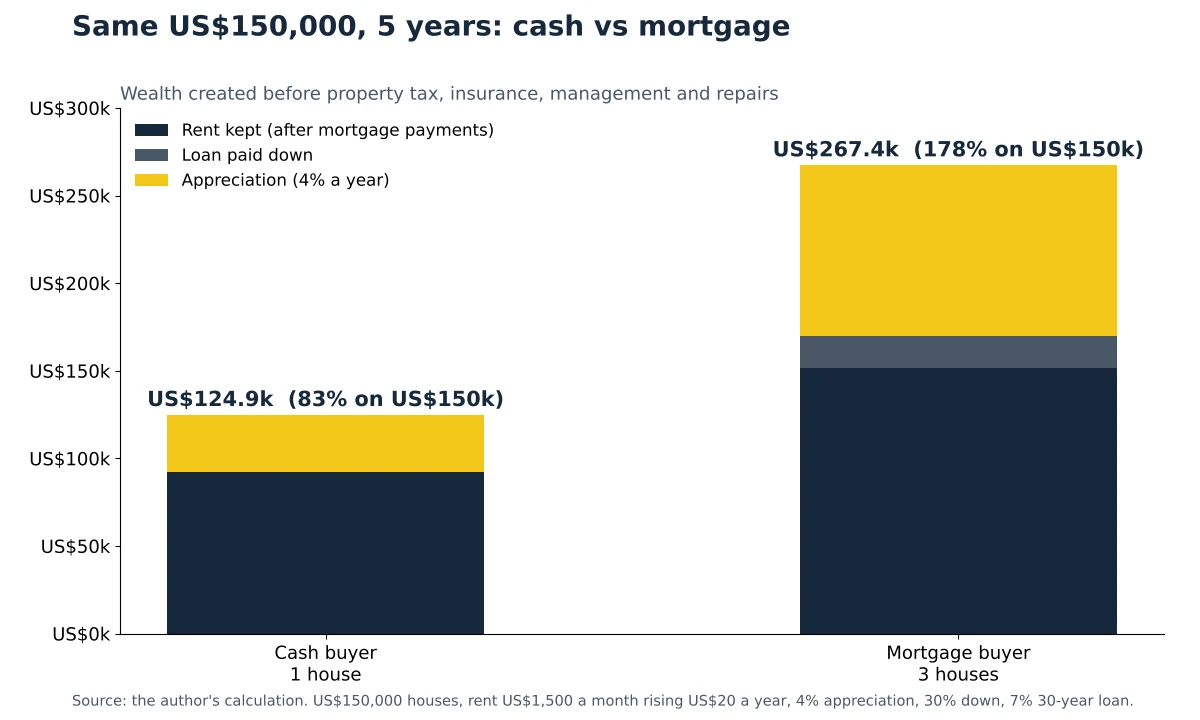
The same US$150,000 over 5 years: Makes about US$124,900 if used to buy a house in full cash vs about US$267,400 with mortgages, after mortgage payments and before running costs.
Cash vs mortgage: which comes out ahead?
On these numbers, the mortgage buyer ends with roughly twice the wealth of the cash buyer, and also with about US$296,500 of debt still owed.
| Cash buyer | Mortgage buyer | |
|---|---|---|
| Houses owned | 1 | 3 |
| Cash put in | US$150,000 | US$150,000 |
| Loans at the start | US$0 | US$315,000 |
| Rent kept after mortgage payments | US$92,400 | about US$151,500 |
| Loan paid down | US$0 | about US$18,500 |
| Appreciation | about US$32,500 | about US$97,500 |
| Wealth created in 5 years | about US$124,900 (83%) | about US$267,400 (178%) |
| After setting aside 20% of rent for management, repairs and vacancy | about US$106,400 (71%) | about US$212,000 (141%) |
| Loans still owed after 5 years | US$0 | about US$296,500 |
The gap holds after setting aside 20% of rent (10% for property management and 10% for repairs and vacancy, the basis the author uses for net figures). Property tax and insurance would reduce both results further, and by more for the owner of three houses.
So the numbers are not saying that more debt is always better. They say something narrower: debt used on a property whose rent comfortably covers the loan, i.e. cashflow positive, is a tool, not the enemy it is often made out to be.
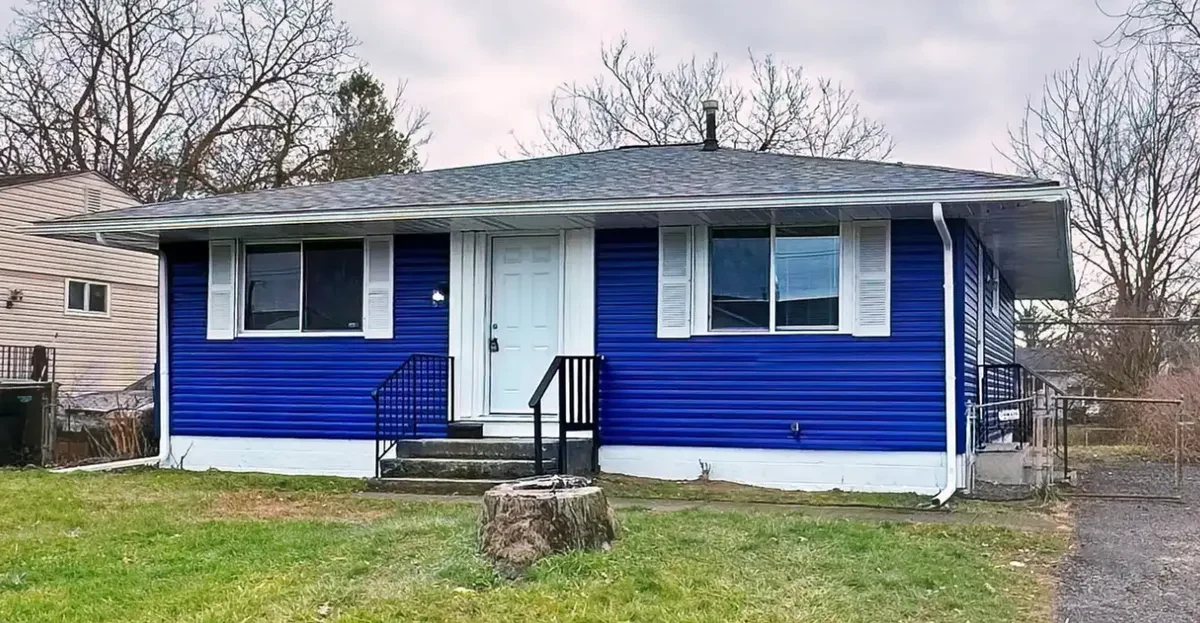
One of the author's own US rental properties. Leverage only helps when the rent from a house comfortably covers its mortgage and all operating expenses, such that the owner’s savings do not need to be touched to cover the mortgage.
What can go wrong with leverage?
Leverage does not protect a bad purchase. It magnifies it.
- Falling prices: if values drop 10%, the cash buyer is down US$15,000 on paper, 10% of the money put in. The mortgage buyer is down US$45,000, because the fall applies to three houses.
- Vacancy: an empty month costs the cash buyer the missing rent. For the mortgage buyer, the mortgage is still due to the lender every month regardless of vacancy.
- More things to break: three roofs, three sets of pipes and three tenants mean three times the chances of something going wrong.
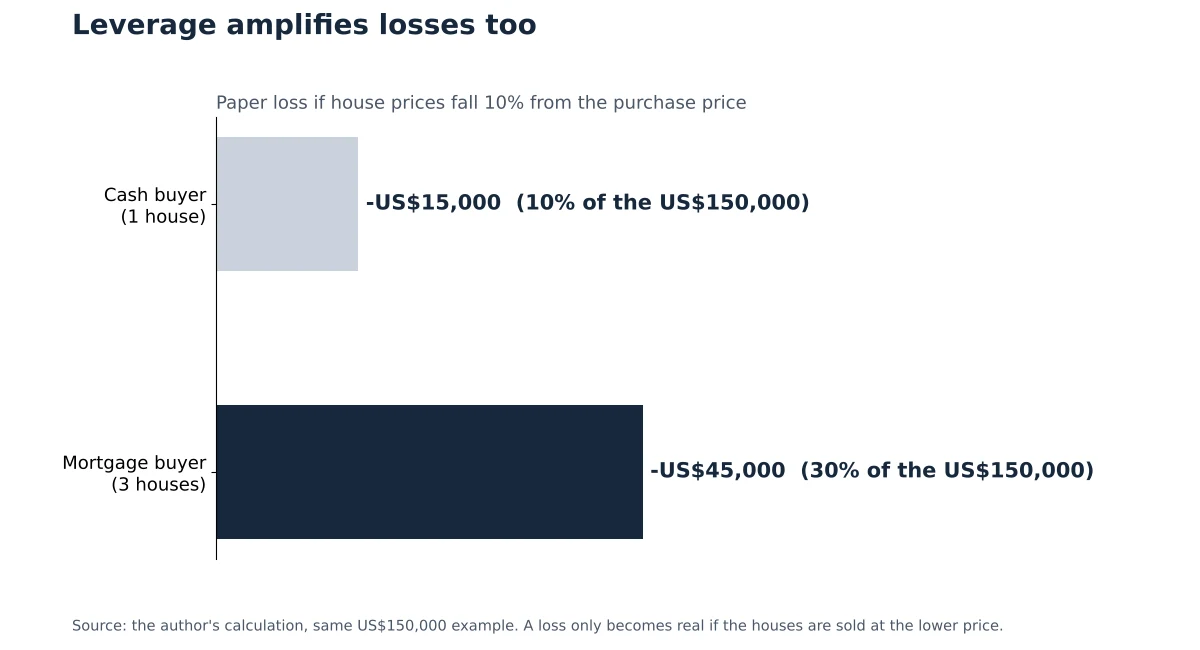
A 10% fall in prices costs the mortgage buyer three times as much as the cash buyer. But a paper loss only becomes real if the houses are sold at the lower price; while rent keeps covering the mortgages, an owner can usually hold on until values recover.
How do you know if a mortgage is worth taking?
Instead of asking whether to avoid debt, ask a better question: is this particular loan buying an asset that someone else, the tenant, is helping to pay for? Three checks answer it.
- Rent vs mortgage payment & operating expenses. In the example, US$1,500 of rent against a US$699 payment leaves about US$800 a month per house, or about US$500 after setting aside 20% for management, repairs and vacancy. If the rent doesn’t cover the payments, the tenant is not paying off your house for you and you need to rely on your salary or savings to fund it.
- Vacancy buffer. Keep enough cash aside to pay the mortgage through an empty month or a large repair, so one bad month does not force a sale.
- Stress test. Re-run the numbers with things going a little wrong: lower rent, a longer vacancy, a higher interest rate. If the deal still holds, the debt is working for the owner, not against them.
Loan terms, interest rates and fees vary by lender and personal situation, so check the details with a qualified professional before borrowing.
Summary: Cash or mortgage for a rental property?
With the same US$150,000, three rental properties bought with mortgages created roughly twice the wealth of one house bought in cash over 5 years, even after paying all the interest. But debt amplifies losses as much as gains, so it only pays on a property whose rent comfortably covers the loan. It is critical to buy the right property in the right market, as a bad market kills a good deal. Before borrowing, compare the rent with the mortgage payment, keep a vacancy buffer and stress-test the numbers.
The cash vs mortgage comparison is also walked through in this video:
How foreigners qualify for a US mortgage, and what lenders look at, is covered in the guide to getting a US mortgage as a foreigner.